



Afro electronic pioneer, Mo Laudi brings Sea Lion Woman to the Dancefloor

Updated: Sep 23
NEW RELEASE / 11 SEPTEMBER 2026
South African rhythm, West African musical foundations and a voice that carries across generations. “Sea Lion Woman — Mo Laudi Touch” brings Kananayé’s interpretation to the dancefloor through Afro house, three-step rhythms and an electronic bassline.
KANANAYÉ / MO LAUDI TOUCH · 120 BPM · AFRO HOUSE / THREE-STEP
Sea Lion Woman — Mo Laudi Touch
Released on 11 September 2026, “Sea Lion Woman — Mo Laudi Touch” is his reworking of Kananayé’s interpretation of the traditional American song famously recorded by Nina Simone. With Clotilde Rullaud Nacoulma’s voice at its centre, the remix brings the project’s West African musical foundations into Mo Laudi’s South African electronic vocabulary.
At 120 BPM, Afro house and three-step rhythms meet an electronic bassline, carrying the vocal and percussion towards the club. It is the first single from the Kananayé Remix EP, scheduled for 6 November 2026, which also features remixes by Murphy Cubic, Kayrop and RMBO.
From Limpopo to the world
Long before Afro house became a fixture of European nightlife, Mo Laudi was already spinning South African sounds there, week after week. Today, the same curiosity runs through his records, exhibitions and sound installations. His latest release, “Sea Lion Woman — Mo Laudi Touch”, brings that approach back to the dancefloor.
Born Ntshepe Tsekere Bopape and raised in Limpopo, Mo Laudi grew up in a politically engaged, intellectual household. As a teenager he painted graffiti and murals around Polokwane. That mix of street culture and deep reading still shapes everything he makes.
London and Paris: planting the seeds
Around 2000, Mo Laudi began building a following in London with South African house, kwaito and other township sounds. His Joburg Project nights brought over kwaito pioneers including Oskido, while the city’s Southern African community helped the parties take root. Weekly residencies followed in London and later Paris. Athens’ National Museum of Contemporary Art credits him as the first South African to establish weekly DJ residencies in both cities.
Along the way, he shared a stage with Miriam Makeba and played alongside Jamie xx and Detroit’s Carl Craig. He also crossed paths with Diplo and Major Lazer as global bass was taking off. These encounters placed him among musicians finding new audiences for sounds that travelled between Africa, Europe and the Americas.
He moved to Paris in 2009, finding that many clubgoers knew little about contemporary South African music. Radioclit and Brodinski helped open doors. In 2013 he helped organise Sharp Sharp Johannesburg at La Gaîté Lyrique, giving South African music a substantial platform in the French capital. Festival appearances followed, including Solidays. At Arte Mix at Le Trabendo in 2021, he shared the bill with Hot Chip’s Joe Goddard and Kiddy Smile.
Globalisto in Lisbon
Lisbon became another regular meeting point. He shared a night at MusicBox with Buruntuma in 2019. In May 2026 he went back-to-back with Boddhi Satva on the PARK rooftop for the Globalisto × Perve Galeria afterparty during ARCO Lisboa, bringing the art fair and the dancefloor into the same evening.
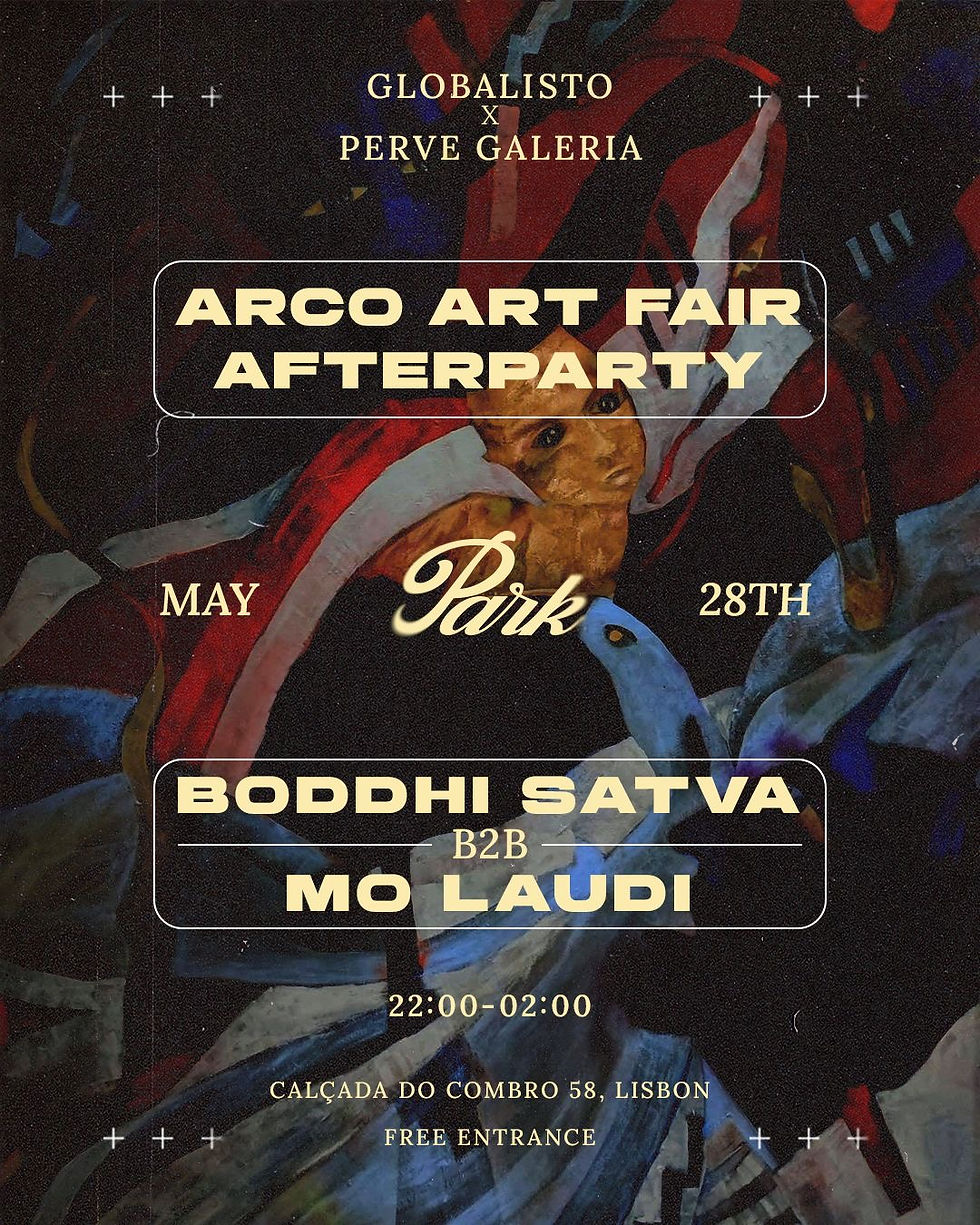
GLOBALISTO × PERVE GALERIA / BODDHI SATVA B2B MO LAUDI / PARK, LISBON / 28 MAY
Globalisto: a club night, a label, a philosophy
Globalisto began as a Paris club night devoted to new Afro-electronic music. In 2015, Mo Laudi turned it into a record label, responding to the difficulty African musicians faced in finding platforms and bookings in Europe. Its first release was an EP by the production act Avant Garde Club Music. The label also provided a home for “Revolution”, his collaboration with Lazy Flow, developed in response to the London riots and the Arab Spring.
Globalisto gradually became the name for a wider artistic philosophy. Informed by African knowledge systems, Botho and thinkers including Achille Mbembe and Fred Moten, it centres radical hospitality: making room for people, histories and sounds that are too often excluded. Botho’s understanding of personhood through relationships gives the idea a practical foundation. Listening, sharing space and remaining willing to learn from others become ways of making art.
That thinking has a long-running home on radio. Tsugi announced Mo Laudi’s Globalisto Sessions in June 2016. Initially broadcast every other Thursday, the programme developed into a monthly residency, connecting his research and record discoveries with listeners beyond the club.
The sound and the records
A Mo Laudi set moves through the wider spectrum of Afro-electronic music. Kwaito and Afro house can give way to gqom, amapiano, Shangaan electro or techno, then accelerate into Tanzanian singeli and the high-speed productions of artists such as DJ Travella. His selections also return to Limpopo, drawing attention to mapanta and artists such as Serokolo 7, alongside dinaka, the Bapedi reed-pipe dance tradition. The pace can shift from hypnotic to frantic and back.
Over more than two decades, he has performed in more than 50 countries, taking that approach from club basements to the Montreux Jazz Festival. His recorded work offers another route through it. The EPs Paris Afro House Club and Jozi Acid, both released in 2017, brought his South African influences into conversation with the city where he had settled. “Por Cima”, featuring Brazilian singer Flavia Coelho, is an original collaboration from this period, combining Afro house with acid and gqom influences.
His remix catalogue includes Calypso Rose’s “Calypso Queen” and Elida Almeida’s “Sou Free”, featuring Flavia Coelho. In 2019, he appeared on “Hometown Girl” with Jerome Sydenham and Fatima Njai. Another meeting, with Gotan Project’s Philippe Cohen Solal at Berlin’s Gretchen, led to a conversation about African connections to tango. Their eventual collaboration, “Afro Bolero”, released in 2020 with Angélique Kidjo, reworked Ravel through African voices and instrumentation.
On Instagram
Beyond the decks
Mo Laudi’s curatorial work developed alongside his music. In 2021, he presented Salon Globalisto at Galerie Bonne Espérance in Paris, drawing attention to figures including painter and musician Gerard Sekoto and photographer George Hallett. EMST identifies him as the first Black South African to curate a group exhibition in Paris.
In 2022, Globalisto: A Philosophy in Flux at MAMC+ Saint-Étienne brought together 19 artists, including Sekoto, Arthur Jafa, Lubaina Himid, Otobong Nkanga, Sammy Baloji and Sam Gilliam. Opening with Sekoto’s Song of the Pick, the exhibition connected artistic experimentation with questions of labour, racial power, migration and collective life. Globalisto: Fragments of Community followed at 31 Project in Paris in 2023.
In 2025, he curated Carsten Höller’s Fara Fara at SOMETHING art space in Abidjan. The exhibition brought together four film works, including the installation exploring Kinshasa’s music scene and the rivalry between Werrason and Koffi Olomidé.
That year, he also co-curated Afrosonica — Soundscapes with Madeleine Leclair at Geneva’s Musée d’ethnographie. Historical recordings, instruments, contemporary art and commissioned compositions explored sound across Africa and its diasporas. At its centre, the Imbizo offered a space for listening, reading and gathering. Globalisto’s hospitality took physical form in the way visitors could spend time together inside the museum.
Sound as a material
His own artworks give those ideas another form. Motho ke motho ka batho, made for the Centre Pompidou’s Ernest Mancoba exhibition in 2019, paid tribute to the South African artist through sound. Congo Square in D# Minor accompanied his collaboration with Sammy Baloji for the Grand Palais in 2021. In Cologne, Helfritz’ Wunderkammer brought his practice into an exhibition questioning the ethnographic gaze and the history of collecting.
Daughters of the Dust. Sons of the Soil was heard in the 2023 Matrimoine project at the Château d’Oiron and the Chapelle Jeanne d’Arc in Thouars. A subsequent composition, Daughters of the Dust. Sons of the Soil, Part 2, was commissioned for Afrosonica and released alongside works by KMRU, Midori Takada and Yara Mekawei. Across these projects, sound becomes a way to attend to histories carried by people, objects and places.
His practice also includes painting, collage, sculpture, video and ceramics. During a 2020 residency at Fondation d’entreprise Martell in Cognac, he collaborated with Zhuo Qi on I Love Black People, a 12-piece ceramic table service carrying historical imagery and anti-racist slogans. His work has appeared at the Dakar Biennale, while Dance of the Ancestors at The Over in Barcelona in 2023 brought together his visual practice in a solo exhibition.
Research and writing
Based between Paris and Johannesburg, Mo Laudi is a research fellow at Stellenbosch University’s Africa Open Institute for Music, Research and Innovation. His sonic lectures bring recorded sound into the presentation of research, connecting historical inquiry with the experience of listening together.
His publications extend that work. With Alexandre Quoi, he edited Globalisto: A Philosophy in Flux — Acts of an Imbizo, published in 2024, bringing the exhibition into dialogue with discussions of art and decolonisation. His essay “Globalisto: Resonances of Transformation, Echoes of Sound, and the Praxis of Empathetic Listening” appeared in the 2024 Sounds Now publication Engaging. He also contributed to the Afrosonica publication and wrote “Kings, Queens, and the African Renaissance: Narratives of Sovereignty and (De)colonization” for the catalogue accompanying Kings and Queens of Africa at Louvre Abu Dhabi in 2025.
Coming next
A new Mo Laudi EP is scheduled for 13 November 2026, continuing an autumn of releases alongside his curatorial and artistic work.
Mo Laudi will also be DJing during Paris Fashion Week.
Listen, connect, book
“Sea Lion Woman — Mo Laudi Touch” is out now.
Globalisto Sessions: Listen on Tsugi Radio


Comments